Siron®One has once again been recognized as a Category Leader in the Chartis RiskTech Quadrant® for AML Transaction Monitoring Solutions 2026, reinforcing IMTF’s position among leading providers of anti-financial crime technology.
In its latest assessment of the AML transaction monitoring market, Chartis evaluated vendors across seven areas spanning data integration, risk typology and analytical modelling, model quality, workflow automation, deployment and performance.
IMTF achieved particularly strong results in Data & System Integrations (4.5), Risk Typology Modelling (4.5) and Analytical Modelling (4.2), all within Chartis’s 4.0–5.0 range for best-in-class capabilities.
Best-in-class capabilities for connected, intelligent transaction monitoring
The results reflect key strengths of Siron®One: connecting data and intelligence across the financial crime lifecycle, combining rules with behavioral analytics and machine learning, and enabling financial institutions to continuously adapt their detection strategies as risks and criminal behaviors evolve.
- Data & System Integrations – 4.5
Siron®One connects internal and external data sources across the financial crime ecosystem, supporting batch, API and real-time integration. By bringing together customer, transaction, screening, risk and case information, financial institutions can build a richer and more contextual view of financial crime risk.
- Risk Typology Modelling – 4.5
A broad library of detection scenarios and more than 300 behavioral profiles help institutions identify known and emerging financial crime patterns. No-code configuration and simulation capabilities enable compliance teams to adapt scenarios and thresholds as risks evolve, without heavy reliance on IT.
- Analytical Modelling – 4.2
Siron®One combines rules, statistical methods, behavioral analytics and machine learning in a hybrid approach to detection. AI-driven capabilities including clustering, behavioral deviation analysis and alert prioritization complement traditional controls, helping institutions identify anomalous activity and focus investigations on higher-risk cases.
Chartis’s research points to this combination of capabilities as increasingly important. Transaction monitoring is becoming more interconnected with the wider financial crime ecosystem, with systems expected to consume and contribute risk intelligence across fraud, KYC, sanctions, adverse media and case management.
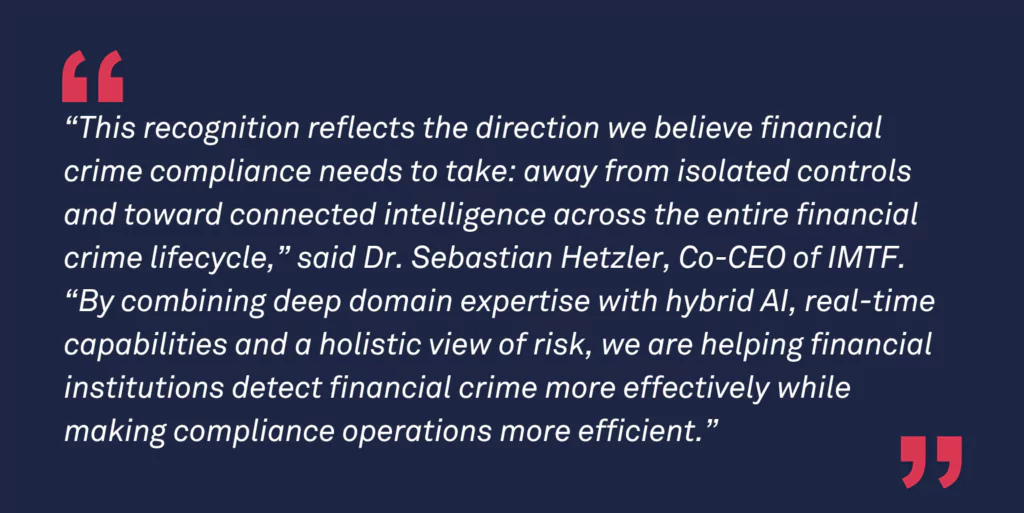
Sebastian Hetzler, Co-CEO of IMTF, commented:
From more alerts to better decisions
AI is also changing what financial institutions expect from transaction monitoring. According to Chartis, the market is shifting away from simply generating more sophisticated alerts toward generating fewer, higher-value alerts, with AI and machine learning increasingly used to improve detection, prioritize risk and support investigations.
This evolution closely aligns with IMTF’s approach to Siron®One. Hybrid AI combines established rules and behavioral analytics with machine learning and AI-assisted capabilities to help compliance teams identify risk more effectively, understand alert context and make faster, better-informed decisions.
At the same time, effective AI requires more than automation. Explainability, governance, auditability and human oversight remain critical as AI takes on a greater role in alert prioritization, investigation and decision support, a development Chartis identifies as a key focus for the next phase of the market.
Why financial crime demands a more connected approach
Financial crime does not operate in silos. Explore why connecting data, intelligence and analytics across traditional financial crime domains is becoming a strategic necessity in our latest white paper “Stop tilting at windmills: Holistic Anti-Financial Crime as a strategic necessity“.