Our teams recently attended some of Europe’s leading anti-financial crime events, including the European Anti-Financial Crime Summit, ACAMS The Assembly Europe, and the 4th Annual FinCrime Leaders Summit Europe.
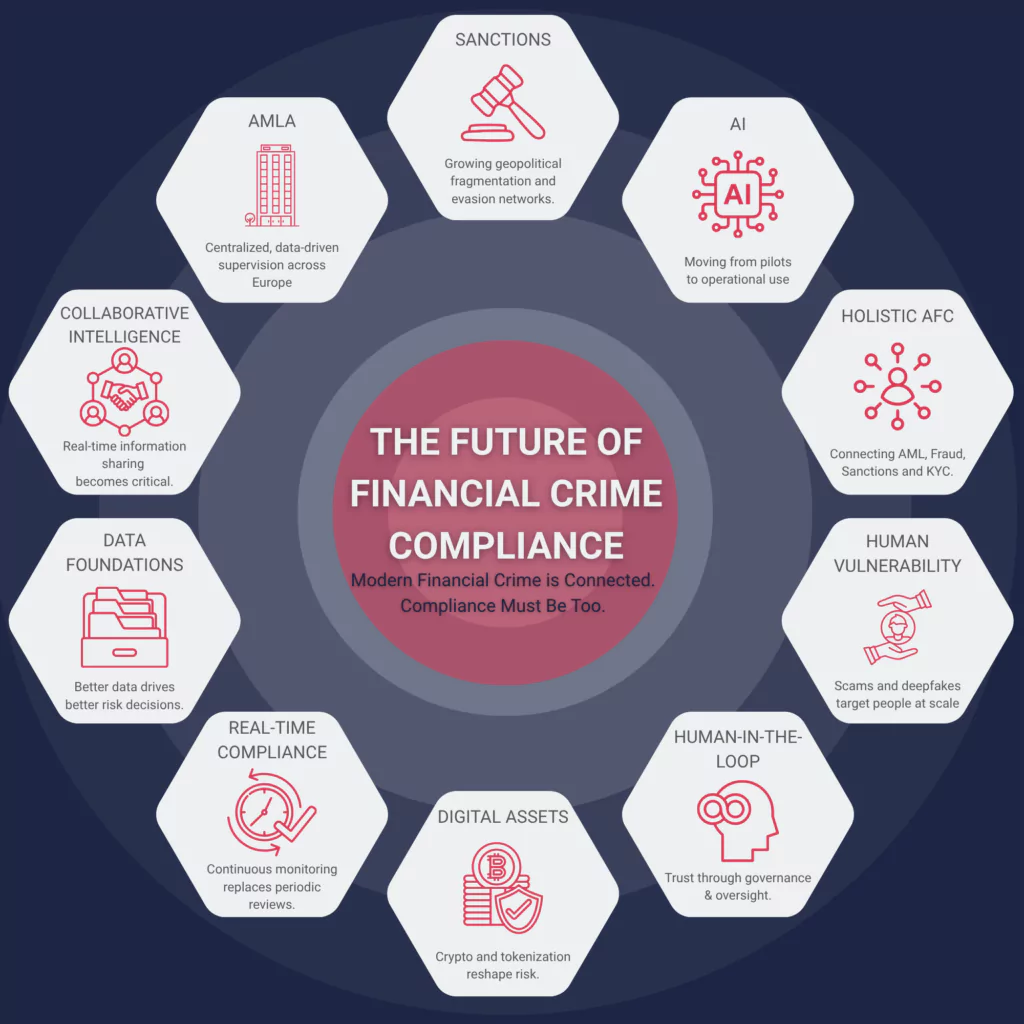
Across these conferences, one message emerged consistently: financial crime compliance is evolving from static control frameworks into adaptive, intelligence-driven operational systems designed for increasingly real-time, interconnected, and fragmented risk environments.
The discussions went far beyond traditional AML compliance themes:. Regulators, financial institutions, law enforcement agencies, and technology providers all highlighted the growing convergence of fraud, cybercrime, sanctions evasion, crypto, AI-enabled threats, and geopolitical instability. At the same time, expectations around operational effectiveness, governance, explainability, and collaboration are rising significantly.
Below are some of the key themes that emerged from Europe’s leading anti-financial crime conferences thus far this year.
Key Takeaways:
- AMLA is accelerating the shift toward more centralized, data-driven, and operationally focused AML supervision across Europe.
- Financial crime risks are becoming increasingly interconnected, driven by the convergence of fraud, sanctions evasion, cybercrime, AI-enabled threats, and geopolitical instability.
- AI in compliance is moving from experimentation to operationalization, with growing focus on explainability, governance, and human oversight.
- Collaborative intelligence, public-private partnerships, and real-time information sharing are becoming critical to combating increasingly transnational criminal ecosystems.
- Financial crime is increasingly exploiting human vulnerability through scams, deepfakes, trafficking networks, and digital exploitation, requiring more adaptive and intelligence-driven detection models.
1. AMLA and the Shift Toward Operational Effectiveness
One of the strongest themes emerging across Europe’s leading financial crime conferences was the growing operationalization of AMLA and the broader transition toward a more centralized and harmonized European AML supervision model.
While previous industry discussions largely focused on the regulatory framework itself, conversations this year reflected a clear shift toward implementation, supervisory execution, and operational readiness. Financial institutions are increasingly recognizing that AMLA will not simply introduce another layer of regulation but fundamentally reshape how anti-financial crime supervision is conducted across Europe.
This transition became even more tangible with AMLA’s recent publication of a reporting package designed to identify the first entities that may fall under direct AMLA supervision from 2028. The initiative introduces standardized reporting templates, eligibility criteria, and cross-border activity thresholds, illustrating how AMLA is rapidly moving from framework creation toward concrete supervisory execution.
At the same time, the discussions also made clear that this transformation will significantly increase expectations around data quality, reporting consistency, and operational transparency. As compliance frameworks become more centralized and data-driven, fragmented systems and siloed compliance processes are increasingly viewed as structural weaknesses rather than operational inefficiencies.
Overall, the conferences reflected a growing industry consensus: Europe’s AML framework is entering a new phase where supervisory effectiveness, operational resilience, and the ability to manage financial crime risks across jurisdictions will become critical differentiators for financial institutions.
2. Geopolitical Fragmentation, Sanctions Evasion, and Trade-Based Financial Crime
Another strong theme emerging this year was the increasing complexity of sanctions enforcement and the growing fragmentation of the geopolitical environment.
While Russia-related sanctions remain highly important, discussions highlighted that institutions must avoid narrowing their sanctions focus too heavily to a single geopolitical context. Iran and Venezuela were repeatedly mentioned as areas where sanctions evasion risks continue to evolve rapidly.
Speakers discussed how fragmented international alignment creates opportunities for evasion networks to operate across jurisdictions with differing enforcement approaches. Several examples were raised around:
- Shadow fleets facilitating oil transfers
- Complex intermediary and shell company networks
- Trade-based sanctions evasion
- Crypto-enabled sanctions circumvention
- Cross-border facilitation ecosystems involving multiple jurisdictions
Trade-based money laundering (TBML) also remained a major focus area, particularly due to the growing complexity of international trade ecosystems and sanctions evasion networks.
Discussions highlighted how AI is increasingly being leveraged to support anomaly detection, document analysis, and contextual intelligence across complex trade environments.
3. AI-Augmented Compliance: From Experimentation to Operationalization
Artificial intelligence remained one of the central themes across the conferences, but the nature of the discussion has clearly evolved.
The industry conversation is no longer centered around whether AI should be used in compliance. Instead, the focus has shifted toward operationalization: where AI delivers measurable value, how it can be governed responsibly, and how it can be integrated safely into operational workflows.
Several presentations showcased AI increasingly acting as an operational co-pilot for investigators and compliance teams through:
- AI-assisted alert prioritization
- Dynamic risk assessment
- AI copilots and investigative assistants
- Automated case summarization
- Continuous monitoring and anomaly detection
- Entity resolution and contextual intelligence generation
- AI-supported document analysis and extraction
One particularly strong theme was the concept of “AI augmentation” rather than replacement. Multiple discussions reinforced that practitioners currently value AI most when it enhances investigator capabilities, reduces operational burden, and improves prioritization, not when it attempts to fully automate high-stakes decision-making.
At the same time, governance, explainability, and human oversight emerged as critical priorities.
As AI becomes more deeply embedded into compliance operations, concerns around explainability, auditability, black-box decisioning, operational trust, and governance controls are becoming increasingly central.
Repeated emphasis was placed on maintaining “human-in-the-loop” approaches, especially for high-risk or regulatory-sensitive decisions. Several speakers also stressed that AI governance can no longer remain purely a technology discussion and must become a core compliance and operational risk topic.
Many of these themes also align closely with the discussions explored in IMTF’s recent e-book AI & the Future of Financial Crime Compliance, which examines how financial institutions can operationalize AI responsibly through governance, explainability, and human-centred compliance models.
4. Data Sharing, Collaborative Intelligence, and Embedded Compliance Ecosystems
Another recurring message across the conferences was that financial crime has become too interconnected, transnational, and fast-moving to combat in isolation.
As criminal ecosystems become increasingly collaborative and technology-enabled, institutions, regulators, and law enforcement agencies are under growing pressure to improve operational intelligence sharing and cross-border cooperation.
Several discussions highlighted the growing importance of:
- public-private partnership initiatives,
- collaborative fraud detection,
- machine-readable information sharing,
- API-enabled intelligence exchange,
- and cross-border operational cooperation.
The launch of Europol’s new “EU Anti-Scam Platform” was one example of this broader shift toward more coordinated and intelligence-driven anti-financial crime ecosystems.
There were also discussions around the possibility of future FATF developments related to information-sharing standards, reflecting the growing recognition that effective collaboration must evolve beyond traditional reporting frameworks toward more operational, real-time, and interoperable intelligence models.
Data quality and data foundations also emerged as recurring themes throughout the discussions. Multiple speakers emphasized that AI models, risk scoring engines, and detection systems are only as effective as the underlying data supporting them. In this context, synthetic data received growing attention for its role in AML testing environments, sandbox initiatives, rare typology simulations, and AI model training.
Overall, the discussions reinforced that future anti-financial crime effectiveness will increasingly depend on institutions’ ability to combine high-quality data, collaborative intelligence, interoperable infrastructures, and real-time operational information sharing.
5. Human Vulnerability and the Expanding Scope of Financial Crime
Beyond technology and regulation, the conferences also highlighted the increasingly human dimension of financial crime.
Several sessions focused on the rapid growth of scams targeting vulnerable populations, including:
- romance scams,
- elderly fraud,
- impersonation fraud,
- AI-generated deepfakes,
- and online exploitation schemes.
Speakers repeatedly stressed that financial crime is increasingly exploiting human vulnerability at scale through digital channels.
Human trafficking also emerged as an important concern, particularly in relation to major global events such as the upcoming FIFA World Cup 2026. Discussions highlighted how large international events can significantly increase trafficking risks and create complex cross-border financial activity that is often difficult to detect through traditional monitoring approaches.
Several experts emphasized the importance of combining transactional monitoring with broader contextual intelligence, including behavioral indicators, high-risk industry patterns, commercial sex advertisement data, and cross-sector collaboration between financial institutions, fintechs, law enforcement agencies, and NGOs.
The discussions also highlighted growing concerns around emerging payment ecosystems, including cryptocurrency and peer-to-peer payment channels, which may create additional blind spots for trafficking detection and investigation efforts.
Overall, the sessions reinforced that financial crime is no longer purely a financial systems issue. It increasingly intersects with social vulnerability, digital behavior, organized crime ecosystems, and geopolitical instability.
Conclusion: Toward Adaptive, Intelligence-Driven Compliance Systems
The discussions across all events demonstrated that financial crime compliance is undergoing a profound operational transformation. The future of financial crime compliance is becoming:
- more real-time,
- more intelligence-driven,
- more collaborative,
- more AI-augmented,
- and more operationally integrated.
At the same time, governance, explainability, operational resilience, and human oversight are becoming more important, not less.
The institutions that succeed in this new environment will not necessarily be those with the most AI or the largest compliance infrastructures, but those capable of operationalizing intelligence responsibly across increasingly fast-moving and fragmented risk environments.
At IMTF, we’re not just following these trends — we’re helping shape them.
Siron®One is a truly holistic anti-financial crime platform designed to address the next generation of compliance challenges head-on. By combining AI-powered intelligence, rule-based detection, intelligent automation, and human-in-the-loop decision-making within one modular platform, Siron®One enables financial institutions to improve detection precision, increase operational efficiency, and strengthen compliance resilience in an increasingly complex and fast-moving regulatory environment.
To learn more about our vision for AI-enabled financial crime compliance, explore our recent e-book: AI & the Future of Financial Crime Compliance.
To learn more about our vision for AI-enabled financial crime compliance, explore our recent e-book: AI & the Future of Financial Crime Compliance.